Start with a need · 8 minute read
What crystal do I need? Start with one sentence.
One sentence. Twenty-three beads. See where the words went—and what a small change actually did.
A sentence we wrote ourselves, run through the live Studio. Not a customer's order.
The first box in the Studio asks what you need. This is where people stop. How much should I write? Is "something calming" enough? If I write it wrong, will I get a strange bracelet?
We wrote one sentence and kept the recipe. We checked it again on September 17, 2026, then tried a shorter brief and one real edit.
What we wrote
The exact input:
"I am starting a new job and want a quiet reminder to speak clearly, stay focused, and keep my own pace. I like deep blue, clear accents, and a restrained everyday design."
There are two kinds of things in that sentence. Three things she wants to do: speak clearly, stay focused, keep her own pace. Three things she can see: deep blue, clear accents, a restrained everyday look. Below we take them separately: the preferences land in color and position; the things she wants to do land in why each stone was chosen.
Settings: 15.5cm wrist, 8mm beads, the under-$100 budget.
What came back
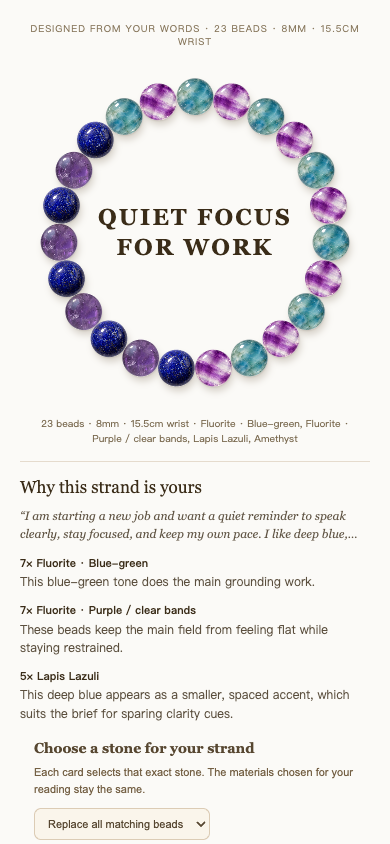
23 beads, four bead choices: seven blue-green fluorite, seven purple fluorite with clear bands, five lapis lazuli, four amethyst.
Count clockwise from the top bead in the preview:
- Positions 1 to 12 alternate the two fluorites, one after the other; 22 and 23 are fluorite too. Those fourteen beads form one continuous field, about six-tenths of the strand.
- Positions 13 to 21 alternate lapis and amethyst. Lapis sits at 13, 15, 17, 19 and 21; amethyst at 14, 16, 18 and 20. Those nine beads are the darker section.
So this is a strand in two parts, one pale and one deep, rather than dark beads scattered evenly.
What each stone is doing
Blue-green fluorite · seven · the base. Fluorite comes in many colors; this one leans blue-green, like lake water. It is calcium fluoride, Mohs 4, softer than quartz, so it deserves a little more care against knocks. The original run’s note reads: "This blue-green element helps build the main field with a cool, composed tone." The bead you have most of decides how the strand feels on the wrist all day. That is the "quiet" and "everyday" in her sentence. The Studio's design note for the fluorite family reads: seeing alternatives clearly and owning the choice you make. In her sentence, that is "keep my own pace": in a first week everything is new, so look first, then decide.
Purple fluorite with clear bands · seven · the clear accents, inside the bead. She asked for clear accents. There is no white or fully transparent bead in the result. The transparency comes from these seven beads themselves: purple and a very pale clear band in the same stone. The original run’s note: "These beads alternate through the main field, where purple and very light clear bands appear in the same bead." The clear part is there without adding a fifth material. It is the same stone as the blue-green in another color, so the design note is the same; the two fluorites together carry her "look first".
Lapis lazuli · five · the deep blue she asked for. Lapis is a rock rather than a single mineral, made of several minerals: lazurite for the blue, with calcite and often small gold-colored flecks of pyrite. It is the only truly deep blue in the strand. The original run’s note: "This darker blue appears as a secondary accent, and its plain, solid-looking color gives the strand moments of visual firmness." Why five beads spaced one apart, rather than five in a row? Five in a row becomes a block of dark. That would be a second base color, not an accent. The Studio groups lapis with the stones it links to expression, and its design note reads: honest expression with room for another person to answer. That is the first thing in her sentence, "speak clearly". Five deep-blue beads spaced apart read as five chances to speak up, not one long speech.
Amethyst · four · between the lapis. Amethyst is purple quartz. Its job here is to keep the five lapis apart, and to echo the purple in the fluorite field, so the two sections share one color. The Studio's design note for amethyst: clarity about what matters to you when many thoughts compete. That is her "stay focused", and it sits between every two chances to speak: decide which sentence before you say it. In our September 17 recheck, the tool described their placement this way: “This subdued purple sits between the deep blue accents, softening the contrast and helping the accent section stay polished instead of sharp.”
So each of the three things in her sentence has a stone that carries it: speaking up is lapis, choosing the sentence is amethyst, looking first is fluorite. These are the Studio's design notes, not things a stone will do for her; which of them she thinks of when she wears it is her own. As a whole, two stones in one section, two in the other, no jump in color, no single bead pulling the eye. That is what "restrained" looks like as a recipe.
What if you write something vaguer?
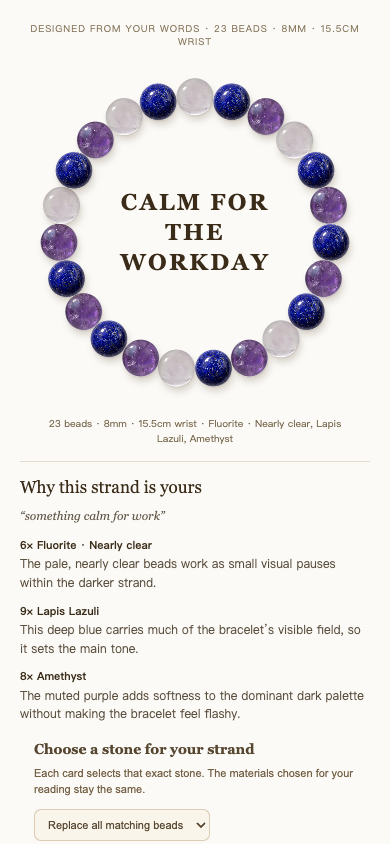
We tried “something calm for work” with the same 15.5cm wrist, 8mm beads and under-$100 budget. This run returned six nearly clear fluorite, nine lapis lazuli and eight amethyst: still 23 beads, still $89. The longer brief returned the original 7 / 7 / 5 / 4 recipe again, with the same bead order.
The shorter sentence still produced deep blue and transparent details. What changed was their share and placement: more lapis and amethyst, fewer fluorite beads. These are two observed results, not a promise that one extra word always changes a particular bead. The tool can vary between runs.
The practical difference is what you can judge: when you write “speak clearly, stay focused, keep my own pace,” you have three specific ideas to compare with the explanation. There is no perfect sentence to unlock.
Want more transparency? Change the matching beads.
Under “Choose a stone for your strand,” leave “Replace all matching beads” selected, then choose the Fluorite · Nearly clear card. In our test, this changed the seven purple/clear-band beads at positions 2, 4, 6, 8, 10, 12 and 23. The seven blue-green beads stayed blue-green.
That distinction matters: the two fluorite materials have separate sets of available appearances. Nearly clear belongs to the banded material’s choices; Blue-green and Lake blue belong to the other material. If you want to change only one bead, choose its numbered position in “Beads to replace” first.
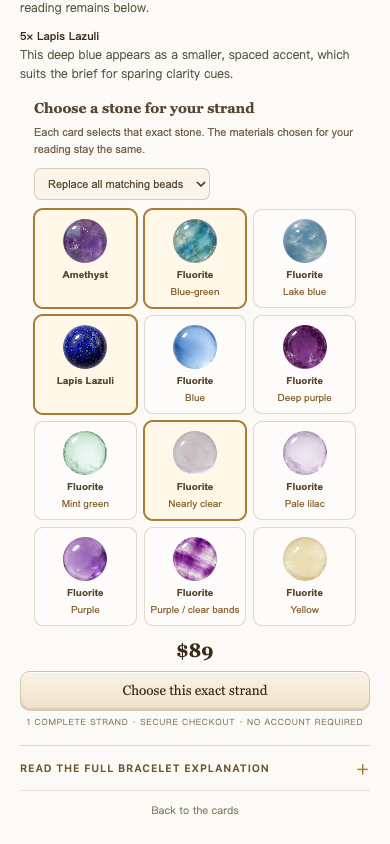
The edited strand kept all 23 positions, the 8mm size, the estimated 15.4–16.1cm fit and the $89 verified quote. It looked more transparent without adding a new mineral. Always wait for your own updated quote before choosing a strand.
If you don't like the change, go back to your choices and edit the words, the wrist setting, the bead size or the budget, then run it again. To place every bead yourself, open the bead-by-bead route.
What is your sentence? Open the Studio and write it down: what you want to do, and the colors you like. Both go into the recipe.
Prefer a finished design? See our finished bracelets.
Example details, recipe & material notes
- 23 round 8mm beads: blue-green fluorite 7, purple fluorite with clear bands 7, lapis lazuli 5, amethyst 4.
- Wrist setting 15.5cm; calculated fit range 15.4–16.1cm, a design estimate.
- Clockwise from the top: lapis at 13, 15, 17, 19, 21; amethyst at 14, 16, 18, 20; the rest fluorite (blue-green at odd positions, banded at even positions; 22 blue-green, 23 banded).
- The Studio identifies the materials and available appearances. We did not find a treatment record for these Studio materials in its public material data; a generic mineral description is not a certificate for these beads.
- Price: as quoted by the Studio on the day. The original recipe, the shorter-brief result and the appearance edit were each quoted at $89 in our September 17, 2026 checks; other recipes and sizes can differ.
- A brand design example, not a customer order. The preview follows this recipe's order; natural bead color and internal detail vary.
Material references: Geology.com: fluorite; GIA: lapis lazuli; GIA: amethyst. These describe minerals generally; they do not identify or certify the Studio beads.
Have several things on your mind? Explore how one bracelet can carry more than one intention.